Continuous Casting
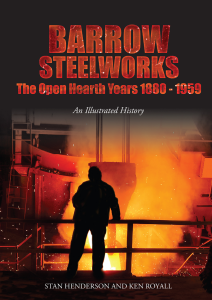
Since the end of the Second World War (1939-1945), there have been some outstanding technical developments in steelmaking (processes, techniques and practices), which have since been adopted on a worldwide basis. These developments include the use of oxygen in bulk; automation; high-speed rolling and continuous casting.
During the 1950s & 60s, the works at Barrow-in-Furness adopted all four initiatives in varying degrees. Most notable for us was the development of High-Speed Continuous Casting.
In this book the authors are attempting to lay down a permanent record of what was achieved locally and thereby, hopefully, preserving the memory of a once-proud industry.




Overview & Preview
88 Pages
Continuous Casting is fundamentally simple. Seen in action, it is deceptively so. Molten steel is poured at a controlled rate into a bottomless, water-cooled mould. From the bottom of the mould emerges a continuous strand of billet, bloom or slab to be cut automatically into the lengths required for further processing. There are few operatives to be seen about the plant, and the whole process goes like the proverbial clockwork.
Notwithstanding, there were a hundred years between the patented scheme of Bessemer and a viable method finally emerging. The process has given the steel industry a valuable, economic production method, dubbed – A Technical Revolution in Steelmaking.
This book is an attempt to recount at least part of the story.
Published in 2021 by Stan Henderson
© Copyright Stan Henderson & KE Royall
ISBN: 9781913898243
1
– The Pioneers –
There have been many pioneers of continuous casting – too many to list here. The following are those whose work was relevant to Barrow.
Sir Henry Bessemer
English inventor, (1813 – 1898) was the son of an engineer. He registered over 100 patent applications in his lifetime. Most notable being for his invention of an inexpensive process of mass producing mild steel from iron (1855). Knighted in 1879, he started the ball rolling with regards to the continuous casting of steel.
Siegfried Junghans
German engineer and metallurgist, (1887-1954), had been the technical and commercial manager of a brass foundry, Schwarz-wald AG. He later became CEO of the Black Forest Metal Trading AG, Company. During the inter-war years he began experimenting with the casting of non-ferrous metals using an open-ended mould.
Upon encountering problems with the molten metal sticking to the internal surface of his mould, he devised and patented a non-harmonic mould oscillation technique. This was around 1933. Then, during 1935 – 36, he began applying his System to the continuous casting of steel, this was at Schorndorf, West Germany.
☆ ☆ ☆ ☆ ☆
Excellent book with wonderful drawings and pictures. As with previous books by the author, this book give valuable insight into steelworks processes, the characters involved and the historical importance of a masterful trade which has shaped the world of engineering and processing. Written in digestible chunks, I would recommend reading previous works by the author as well as this as a stand alone piece.
☆ ☆ ☆ ☆ ☆
Another fascinating book by this knowledgeable author. Full of interesting information written in layman’s terms and includes lots of b&w and colour images of the plant, and the workers behind the process.
Other books by Stan Henderson you might like