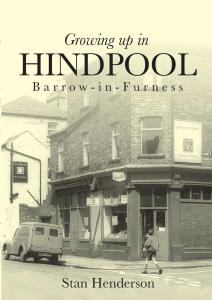
Growing up in Hindpool
In this updated follow-up to Growing Up in Hindpool, Barrow-in-Furness, 2019, the author completes his patchwork quilt with respect to the industries, institutions and businesses to which he has been directly or indirectly involved. In the book, the reader is taken on a walk out of the district and, via Lower Cocken, into Ormsgill, then back into Hindpool. During this walk, which 60-years ago, was undertaken at least once per week, the author reflects upon aspects of 1950’s life, bygone industries, landmarks and some of the local characters that made Hindpool one of Barrow’s most fascinating places in which to belong.


Overview & Preview
84 Pages
Contains lots of colour and B&W photos
Had I kept a diary or journal during the 1950s, then what follows in this book would have been a typical account of almost any Sunday during the summer of 1959. In fact, the narrative is structured around such a Sunday and a ritualistic walk during which the author reflects upon aspects of life, together with some of the bygone industries, landmarks and local characters from this post-war decade.
During the 1950s we were still recovering from the horrors of war. In Hindpool we were growing up amongst war-ravaged buildings, bombsites and waste grounds. The people were somehow quite different from today being, ‘very British’ (whatever that means). Nevertheless they were God-fearing, polite, neighbourly, respectful and they exercised restraint.
Moreover, we were protected by a robust police force that didn’t despise us.
In writing this book, which is a follow-on volume to Growing Up in Hindpool, 2019, the rationale has been to try to impart as much of what was observed and experienced during the period to a younger generation, who may be interested in learning just how different things were. Included are several fifties vignettes, together with some personal opinion.
Published in 2020 by Stan Henderson
© Copyright Stan Henderson
ISBN: 9781916275836
• Chapter One •
Sunday Morning
It is a fact of life that – we don’t know what we’ve got until it’s gone. Nothing brings this home to me more than the loss of the traditional Sunday.
Sunday, that once special day, a day of rest, a family day – a very nice day in fact. But, as a youngster growing-up in 1950s Britain, it was a long, boring day – it seemed to be twice as long as the other days of the week. It culminated, invariably, with the finishing of homework, polishing shoes, bathing and generally getting things ready for school – and then early to bed.
A typical Sunday in our household started at around 8 am – Dad would not allow us to sleep in. “You want nothing lying in bed and wasting your life away on a lovely morning like this”, he would say. My sisters and I would then rise, wash and come down to our breakfast which, if you wanted and being Sunday, was usually eggs and bacon. From our house on Hood Street we could hear – very clearly – St James’ bells as they summoned the flock to Holy Communion. The service started at 9.30am. I think Mass at St Mary’s began at 7.15am.
An alternative to the above was when a fishing trip was planned. These trips, which were looked forward to and enjoyed immensely, would all depend on several factors. First and foremost, Dad’s shift at the steelworks, then the weather – mainly the wind factor – anything more than a force 3 was considered a no-no. Secondly was the tide, a smallish tide being preferred with high-water at around 3am (this, then, would mean a 6 or 7am set-off as we couldn’t get under Jubilee Bridge until 3-hours after high-water [3-hours ebb]. The boat’s mast, not being set in a tabernacle and thereby not collapsible, prohibited this).
Heading off down the Channel with the tide (current), we would reach Piel in around 25 minutes. There was something special about being out on the water at the start of a calm, new day. Walney Channel during this period was quite a busy thoroughfare. Passing first the slipways of Messrs.’ Vickers, we could view vessels under various stages of construction. First to be passed was 10-berth where Dreadnought was taking shape and then number 1-berth where Oriana was being painted in the ubiquitous corn colour of the Orient Line, in readiness for her launch in the November. A little further on, the dredger, Piel was anchored in the fairway and working away, preparing for the launch. Just beyond the slip-ways and on her mooring at the start of the deep-water berths would be the Trinity House pilot boat, Irene Allen, its role being to guide ships into the tidal waters of Walney Channel and up to the dock gates. Next to be passed would be the Belfast Berth where the British Rail dredgers tie-up. The Belfast Berth was where folk could at one time embark for Northern Ireland, Fleetwood and the Isle of Man.
This Berth had its own railway terminal (Ramsden Dock Sta.). Passing the entrance to Ramsden Dock we would see the hulks of vessels that had been towed out of Devonshire Dock by ship-breaker, Ward, and then beached for final cutting up.
☆ ☆ ☆ ☆ ☆
What a good read, takes me back to my childhood in hindpool.
☆ ☆ ☆ ☆ ☆
Interesting and well written
Other books by Stan Henderson you might like