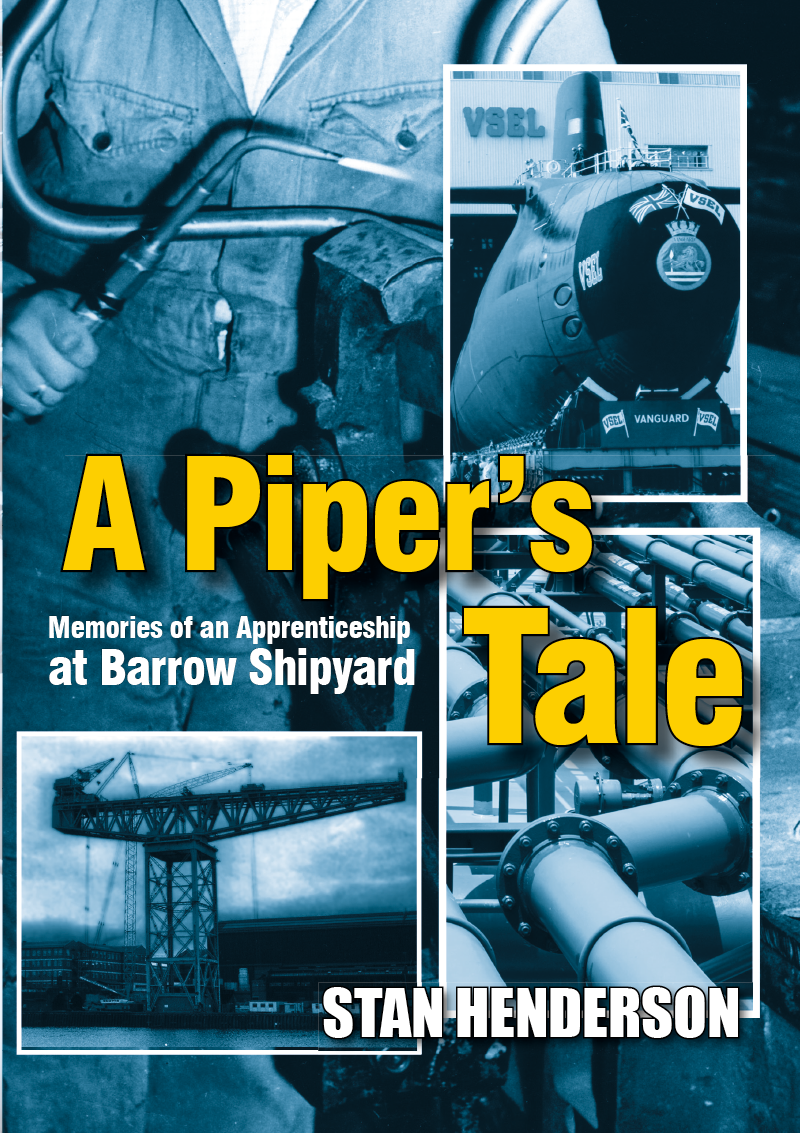
A Piper’s Tale
Based on a memoir plucked from his family history, A Pipers Tale records the impressions made on a teenager as he makes his way into the thorny world of shipbuilding. A world in which the author, during the 1960s, witnessed the change from traditional shipbuilding – where vessels were constructed with a minimum, but adequate, level of technical support via long established trade practices and skills – to the cutting-edge of science-based projects as the Shipyard at Barrow-in-Furness became a ‘Leader in Marine Technology’ with the making of sophisticated warships and first-of-class vessels.
Also covered, whilst saluting the Yard’s Plumbing Fraternity, is the writer’s amazement at the wealth of characters and personalities. With a dramatis personae of which any Dickens aficionado would be proud, the book dips into levels of humanity never before explored in a local industrial history.



Overview & Preview
108 Pages
Includes lots of colour and B&W images and diagrams.
This book is an honest attempt to write, from memory, an account of my experiences and observations as an apprentice at Barrow Shipbuilding Works during the turbulent decade of the 1960s. To a large extent it represents the impression made on a sixteen year old teenager making his way into the world of heavy engineering.
During my time I was fortunate to have experienced the changeover from the old days, the era which represented the days of efficient, commercial shipbuilding where the once bowler-hatted head foremen ruled and were responsible for not only discipline, manpower and trade skill but also such as estimating, planning and material ordering. The latter, during the 1960s, being wrested and placed with the drawing offices.
Published in 2017 (updated in 2022) by Stan Henderson
© Copyright Stan Henderson
ISBN: 9780995619081
Chapter 1
FIRST YEAR
It is recalled that Monday the 10th of May, 1965 was a lovely spring day.
It was in fact the start of a very pleasant summer. The time was 7.15am and I was making my way across the High-Level Bridge towards Barrow Island. Once over the bridge I turned left into Kings Gate continuing down the long road that ran parallel to the East Shop. At the end of this road was the works’ garage and the entrance to the Buccleuch Dock Plumbers Shop. Once inside I reported to the foreman’s office where I asked for Mr Lowe. Shop foreman1 Jimmy Lowe (Lowie), a red-faced middle-aged man in a belted white boiler suit and flat cap (hard hats at this time were only worn by managers and foremen working on the Berth), passed me on to charge-hand Harry Kirkham2. I was to find that Harry, a dapper kind of guy with a David Niven ‘tash, actually carried the shop and when there was an issue regarding some aspect of a job or it was proving difficult translating or understanding a drawing, you would hear the call – “send for Harry”. He was also a master of ‘bare-rod’ welding.
The Plumbers’ Shop was situated at the southern end of, but not accessed from, the East Shop which was part of Vickers Engineering Group (VEG).
My position had been secured with the shipbuilding side (VSG) – the corporate name had just been changed from Vickers-Armstrong. Also at the end of the East Shop building was a coal-fired boiler house which produced the steam to heat that area of the works. I recall that every two minutes or so a relief valve would blow to atmosphere – as if to purposely cause annoyance.
From my enquiries I found that a Collier came in every Monday and docked at the coal wharf, which was east of the Ship Smithy. This was unloaded by mobile steam cranes with coal being distributed, via rail, to most boiler houses on the works complex. This boiler house also housed the work’s buzzer for the dock areas. Next door was Jimmy Jackson’s Store. This store contained a stock of non-ferrous pipe fittings, mainly from Yorkshire Imperial Metals in Leeds. Jimmy Jackson was a senior plumber and, probably because of his years, was put in charge of this store. Also in the area but tothe left of the shop entrance was Alan Gunthorpe’s Sheet Iron Store. Alan was also a plumber who suffered with a wry-neck which meant that his head was badly tilted to one side. Because of this disabling feature he too had been given a store man’s job. (Alan was ‘soccer mad’, he keenly supported Barrow AFC and at our first encounter asked if my dad was the Henderson who had played at Holker Street – which I confirmed. “The bugger missed a sitter at The Bridge during a 3rd round cup-tie against Chelsea,” he was quick to point out). Gunthorpe’s Store housed, amongst other things, a full range of steel pipe fittings made and supplied by Clyde Tube Forgings, near Glasgow.
This range included tight radius bends, eccentric and concentric reducers and swept tee pieces, all with a 45 weld prep. (It had been the practice up until this time for the head foreman to maintain a good depth of stock items such as the aforementioned fittings as well as the standard range of tubing to ensure contractual obligations could be fulfilled. This policy was soon to cease with ordering responsibility passing to the Drawing Offices. This was, in part, because of newer materials becoming available and also the fact that contracts were becoming more exacting in their requirements).
☆ ☆ ☆ ☆ ☆
A lovely and at times funny book for anyone interested in the goings on in a shipyard.
☆ ☆ ☆ ☆ ☆
Loved it .
Other books by Stan Henderson you might like