Barrow Steelworks
The open hearth years 1880-1959
The 1880s were a decade of change for Barrow works with some of the main players departing the scene. The arrival of the basic method of steelmaking, developed by ‘amateur’ metallurgist Sidney Gilchrist Thomas, took away the lucrative position held by the directors and shareholders who had drained the coffers leaving virtually nothing for re-investment. After the Great War the once monster-iron-mining-smelting company was limping along. Following a reconstruction initiative during the 1920s it started an asset disposal programme in the early 1930s selling-off the collieries and by-products plant at Worsboro’ near Barnsley. As the decade faded closure loomed. And then a sudden and dramatic turning point! The evacuation of Dunkirk at the start of World War Two together with the blocking of special steels from Scandinavia produced a demand for the kind of steel the making of which Barrow was a past master. Coming under the management of the United Steels combine Barrow works entered a Renaissance period and a phase of secure employment ensued – even an apprentice intake followed. Under United Steel’s banner Barrow would see security of employment for a new generation.
This book covers the open hearth years, the actual process as worked at Barrow and the main changes the works underwent together with some of the personnel involved in taking the works forward into the middle of the 20th century




Overview & Preview
108 Pages
Includes lots of colour and B&W images and diagrams.
It is difficult from our present standpoint to appreciate the immense size the works had once been, even by 19th century standards, it made other works look positively Lilliputian. It had been estimated in one quarter to have left the German concern Krupp far behind. It was also, according to local historian J.D. Marshall, the most successful company of its kind – in that it could pay a dividend of 20% for eleven years. Barrow had been the show works of the world and one time largest employer in Cumberland and North Lancashire. It had been the model used by the great Andrew Carnegie in building his own steel empire in the United States. At Barrow the heady days of ‘empire’ were numbered, there were clear signs that the heavily exploited iron ore deposits were becoming impoverished.
The year 1880 was a pivotal year for the Steel Company, indeed the decade would be one of change and frustration. J. T. Smith had just completed a re-modelling of the Bessemer plant (and then seven years later would retire), in removing the converter vessels and hammers from the northern end of No.3 shed he had made space for the new open hearth furnaces. Throughout the decade Barrow still remained one of the Bessemer strongholds, although open hearth steelmaking would become the main process at the works until 1959.
Published in 2017 by Stan Henderson and Ken Royall
© Copyright Stan Henderson & Ken Royall
ISBN: 9780995619050
1
1880 – 1918
The open hearth steelmaking process was based on the work of Sir William Siemens, a German engineer, who later became a British subject.
Siemens came to the north of England twice, once in 1846 and then later in 1874 when he spoke at the dinner given to the Iron and Steel Institute in Barrow. – “It was”, he said, “in the year 1846 that I visited the district from across the seas, and that beautiful ruin Furness Abbey. At that time I had heard that there was a village called Barrow – a village of, perhaps, 300 inhabitants – but all the signs I could see of iron smelting were a few tip-forges and an old tip where puddling ore was shot occasionally. . .”
Siemens applied the regenerative principle to the reverberatory furnace (developed in the eighteenth century by Henry Cort for his Puddling Process) whereby a honeycomb of fire bricks, called the checkers, (also referred to as chequers), beneath the hearth absorbs heat from the waste gases and then returns it to the incoming gases in an alternating cycle. This method could save up to 75% of the fuel previously used. Together with Frenchman Pierre Martin, who proposed the diluting of the pig iron with scrap wrought iron, they developed what became generally known as the Siemens-Martin Open Hearth Process. The early furnaces were fuelled by coal fires, these fires were sited at each end of the furnace but this arrangement often led to problems with the hot air flows causing clinkering of the ash with heavy wear of the fire bed. Siemens overcame this problem by inventing the gas producer which took the fire and all solid fuel right away from the furnace and the checkers. It was this improved open hearth furnace model that Barrow bought into.
Barrow Steelworks
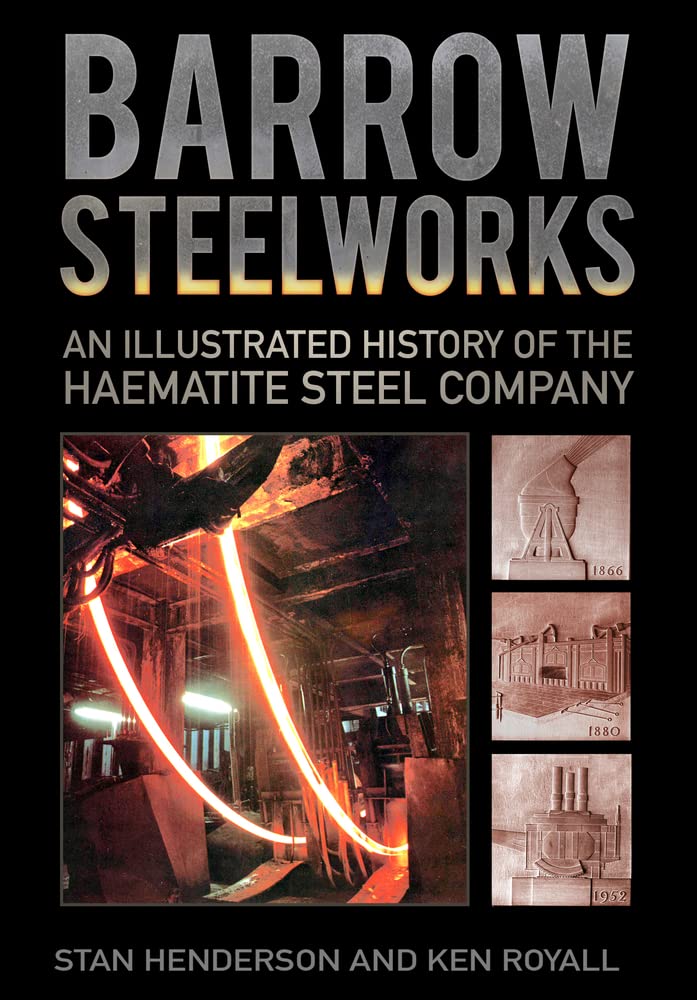
During the second half of the nineteenth century, Barrow-in-Furness became a pioneer in iron and steel production. It went on to grow astronomically – owning collieries in three counties and ore mines in two – and became the largest integrated steelworks in north Lancashire and Cumberland and, at one time, the largest steelworks in the world. Its success was due, in part, to having the prestige of three dukes as directors, as well as to being only 2 miles away from one of the largest and richest iron ore mines in the country. Written by two former employees of the works, Barrow Steelworks chronicles the company’s past from the early empire through the inter-war and post-war years, the development of continuous casting in the 1950s, which revolutionised steelmaking, and, finally, the struggles and ultimate demise from the 1960s onwards of this once prominent industry.
Other books by Stan Henderson you might like